Guinea Pig Breed Characteristics
Understanding the traits — coats, colors, markings, and features — that set the breeds apart.
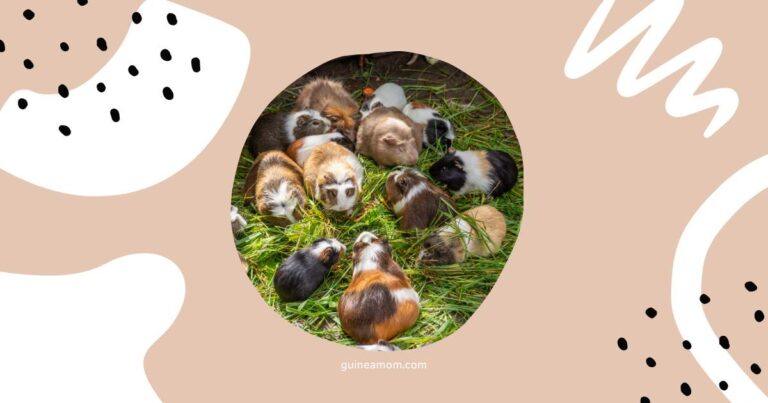
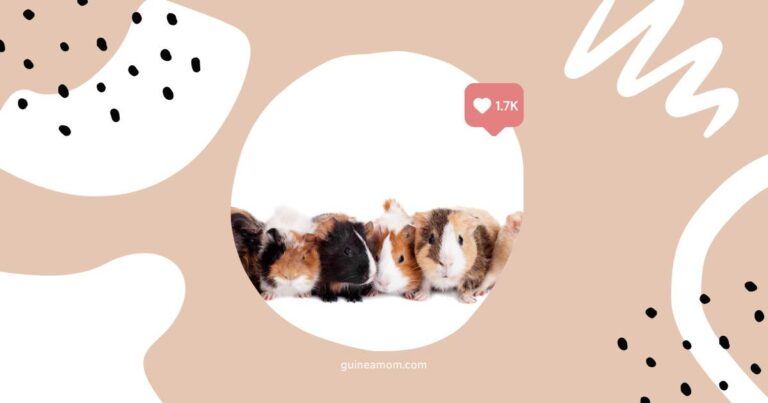
Guinea pig breeds are defined mostly by their coats — and a handful of key characteristics explain nearly all the variety you’ll see. The big dimensions are coat length (short, long, or hairless), coat texture (smooth, dense, curly, or rosetted), structural features like rosettes and crests, and a rich palette of colors and markings (solids, agoutis, roans, tortoiseshells, Dutch patterns, Himalayan points, and more). Beyond the coat, breeds are actually quite similar: most guinea pigs share a comparable body size, build, and lifespan, and — importantly — temperament is individual, not breed-determined. The most practical characteristic for owners is grooming need, which follows directly from coat length and texture. Understanding these traits helps you read any guinea pig you meet and choose one whose characteristics suit your life.
How Guinea Pig Breeds Are Characterized
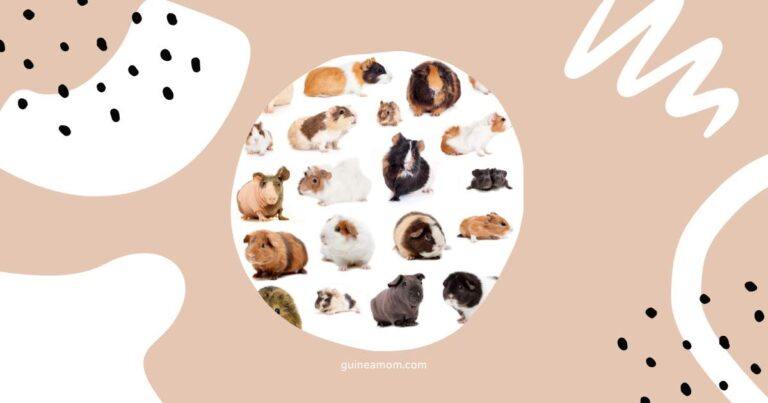
When breeders and clubs distinguish one guinea pig breed from another, they’re focused overwhelmingly on the coat — its length, texture, growth direction, and any special structural features — together with color and markings. That’s why two pigs of completely different breeds can be near-identical in body and behavior, yet look worlds apart.
So rather than memorizing breed after breed, it’s often more useful to understand the characteristics themselves. Once you know how to read coat length, texture, rosettes and crests, and color patterns, you can make sense of almost any guinea pig — pedigree or lovable mixed-breed alike. Let’s go through the main characteristics one by one.
Characteristic 1: Coat Length
Coat length is the first and most consequential characteristic, because it largely determines how much grooming a pig needs.
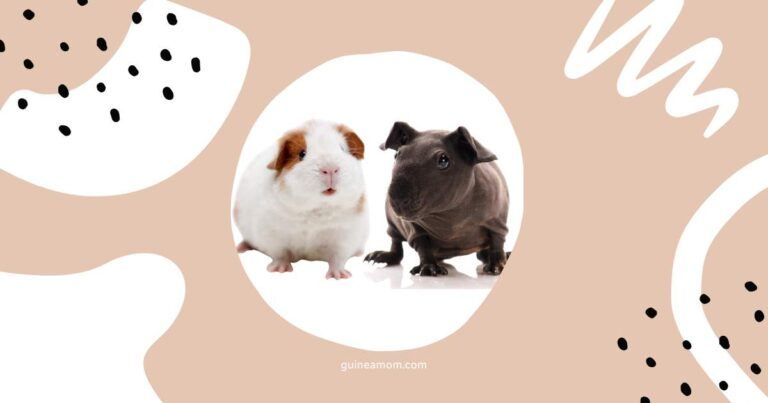
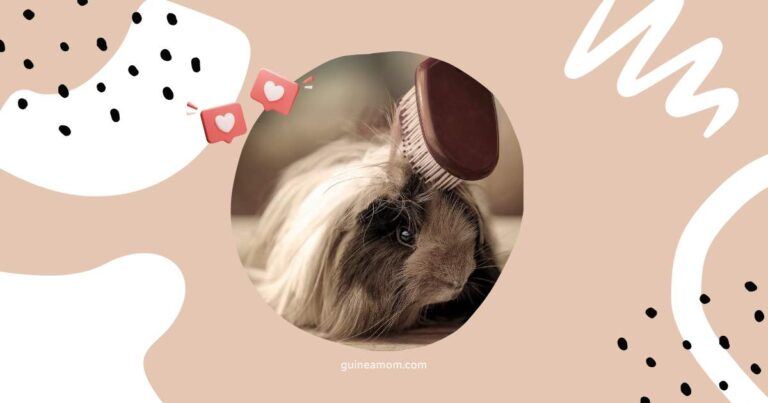
Short coats are the most common and the easiest to care for, needing little more than occasional brushing. Long coats can grow dramatically long and flowing, and demand a serious daily grooming commitment to prevent tangles, matting, and hygiene problems. Hairless guinea pigs sit at the far end of the spectrum — with little or no coat, they need no brushing but require special care around temperature and sun exposure instead.
This single characteristic is the one most worth weighing up before choosing a pig, since it dictates so much of the day-to-day care.
Characteristic 2: Coat Texture
Beyond length, the texture of the coat creates much of the visual variety between breeds.
- Smooth coats lie flat and glossy against the body — sleek and neat.
- Dense, wiry coats stand up off the body with a plush, slightly coarse feel, giving a fuzzy, “teddy-bear” appearance.
- Curly coats form curls or waves, which look beautiful but tangle easily, especially when long.
- Rosetted coats grow in swirling cowlicks (more on these below), creating a spiky, tufted, characterful look.
Texture often combines with length — a coat can be short and curly, long and curly, smooth and short, and so on — which is exactly how the different breeds come about.
Characteristic 3: Rosettes and Crests
Some of the most distinctive breed characteristics are structural — the way the hair is arranged rather than its length or texture.
Rosettes are swirls or cowlicks where the hair radiates out from a central point, like a little starburst in the coat. Breeds known for rosettes wear them across the body, ideally in a balanced arrangement, producing that spiky, slightly unruly appearance many owners adore.
Crests are a single rosette sitting on the forehead, creating a “crown” or tuft on the head. A crest can appear on an otherwise smooth, short-haired pig or atop a long, flowing coat — and whether the crest is white or matches the body is itself a defining feature in some breeds.
These structural traits are a great example of how guinea pig characteristics are about how the coat grows, not just what it’s made of.
Characteristic 4: Colors and Markings
Here’s where guinea pigs get truly varied — and it’s a characteristic that cuts across all breeds. Color and markings come in a beautiful range, and learning the main types helps you describe any pig you meet.
- Self (solid): a single, uniform color all over — black, white, cream, chocolate, red, and more.
- Agouti: each hair is banded with two colors, giving a flecked, “ticked” appearance similar to a wild rabbit’s coat.
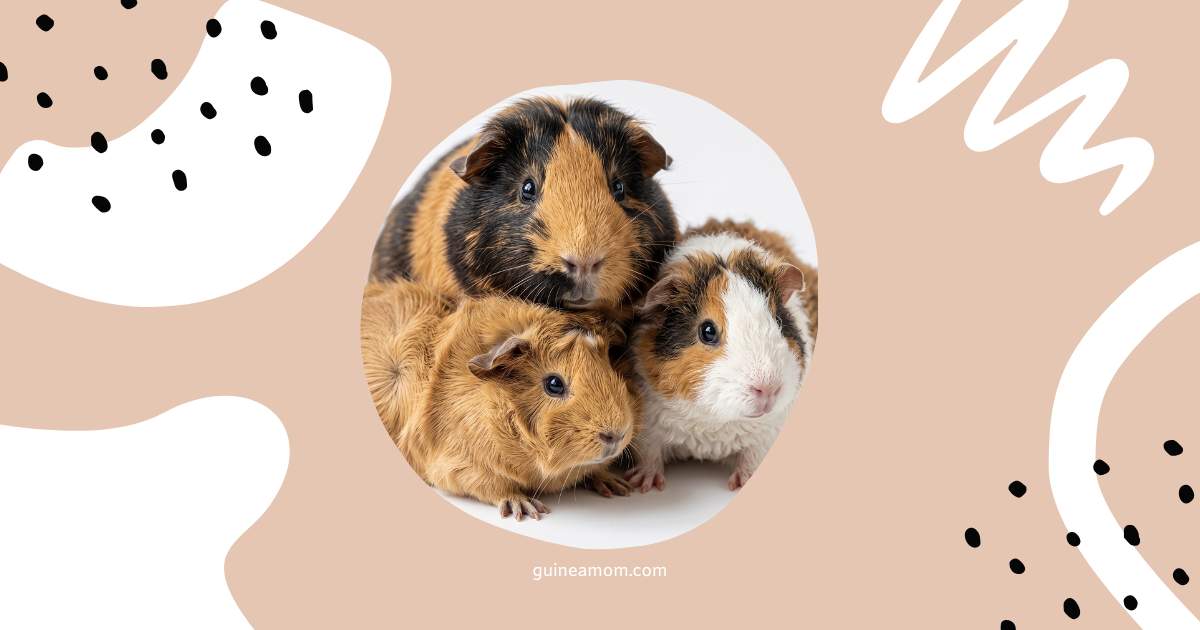
- Roan: colored hairs evenly mixed with white throughout the coat, creating a speckled, frosted look.
- Brindle: colored and dark hairs intermingled, often a blend of red and black.
- Tortoiseshell: distinct patches of two colors (classically black and red) across the body.
- Dutch: a recognizable pattern with a white front and colored rear, plus a white blaze on the face — much like a Dutch rabbit.
- Himalayan (pointed): a white body with darker “points” on the nose, ears, and feet, reminiscent of a Siamese cat; the points can deepen or fade with temperature and light.
- Dalmatian and Magpie: spotted patterns, with white coats marked by colored spots.
- Crested markings: as noted, the color of a forehead crest (often contrasting white) is a marking characteristic in its own right.
Because these colors and markings can appear on many different coat types, the combinations are nearly endless — part of what makes guinea pigs so charming to look at.
Characteristic 5: Body, Size, and Lifespan
Here’s a characteristic that’s notable for how consistent it is. Unlike dogs, guinea pig breeds don’t vary dramatically in body size or shape. Most adult guinea pigs fall within a fairly similar weight range and share a compact, rounded, sturdy build, with boars (males) tending to be a little larger than sows (females).
Lifespan is similarly consistent across breeds — guinea pigs generally live several years with good care, regardless of breed. So while coats and colors differ wildly, the underlying animal is remarkably uniform from breed to breed. (Hairless breeds are the partial exception, with some differences in metabolism and care needs tied to their lack of coat.)
Characteristic 6: Grooming and Care Implications
The practical payoff of all these characteristics is what they mean for care — and coat length and texture are the headline.
Short, smooth, dense, and wiry coats are generally low-maintenance, needing only occasional brushing. Long coats — especially curly or rosetted long coats — require daily grooming, regular trimming, and extra hygiene attention around the rear to prevent matting and soiling. Hairless pigs swap grooming for environmental care: warmth, sun protection, and often a little extra food to maintain body heat. Knowing a pig’s coat characteristics tells you, at a glance, roughly what their care will involve.
Characteristic 7: Temperament — The Individual Factor
It’s tempting to treat temperament as a breed characteristic, but with guinea pigs this is largely a myth. While you’ll hear breed-based generalizations, a guinea pig’s personality is shaped far more by their individual nature, early experiences, and how they’re socialized than by their breed.
So while coat, color, and markings are genuine breed characteristics, temperament really isn’t a reliable one. A shy or bold, cuddly or independent pig can come in any breed. The kindest and most accurate approach is to meet a pig as an individual and let their character reveal itself, rather than expecting it to match a breed label.
Bringing It All Together
Put these characteristics side by side, and a clear picture emerges: guinea pig breeds vary enormously in coat length, texture, structure, and color, are remarkably similar in body and lifespan, and don’t reliably differ in temperament at all. For an owner, the single most useful characteristic to weigh is the coat — because it determines grooming — followed by simply choosing the colors and markings you find most appealing.
Understanding these traits lets you appreciate the full diversity of guinea pigs, describe any pig accurately, and choose one whose characteristics genuinely fit your home and lifestyle — while remembering that, underneath every coat, the core animal and its needs are the same.
Key Takeaways
- Breeds are defined mostly by the coat — length, texture, structure, and color — not by body or behavior.
- Coat length (short, long, hairless) is the most consequential characteristic, because it determines grooming needs.
- Coat texture (smooth, dense, curly, rosetted) creates much of the visual variety, often combined with length.
- Rosettes and crests are structural traits — swirls across the body, or a single “crown” on the head.
- Colors and markings are richly varied — selfs, agoutis, roans, brindles, tortoiseshells, Dutch, Himalayan points, and spotted patterns — and appear across all coat types.
- Body size and lifespan are fairly consistent across breeds, unlike the dramatic variation seen in dogs.
- Temperament is individual, not a breed characteristic — personality depends on the pig, not the breed.
- For owners, coat characteristics matter most, since they dictate grooming and care; otherwise, choose the look you love.
This article is intended as general educational information for guinea pig owners. Breed standards, color names, and classifications can vary between regions and breed associations. For health and care guidance — particularly for long-haired or hairless guinea pigs — consult a qualified veterinarian.